Latest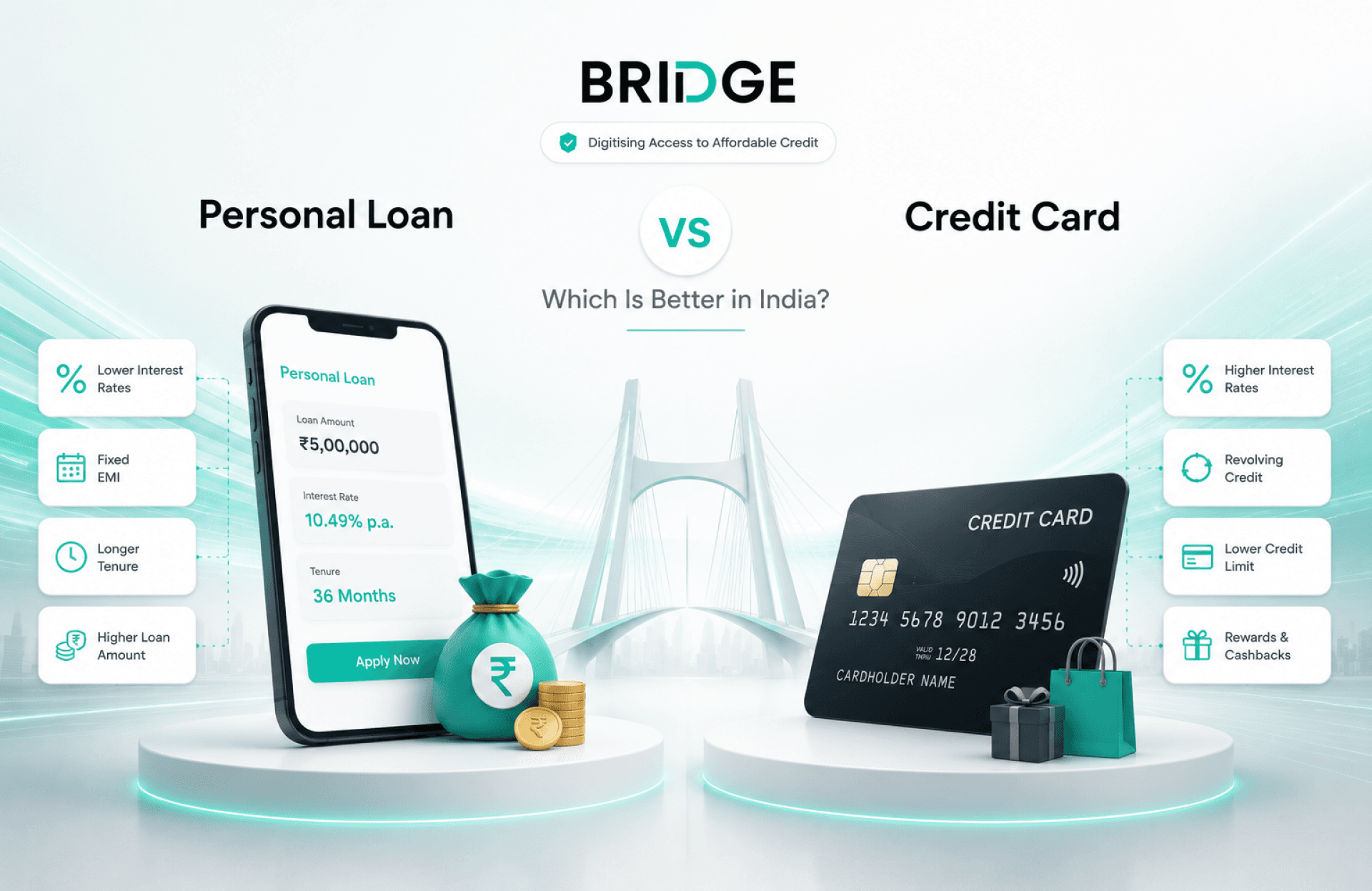
Introduction
When you need quick access to funds, two of the most popular options available in India are a personal loan and a credit card. Both are forms of unsecured credit, meaning you do not need to pledge any collateral. However, they work very differently and are suited to different financial situations.
Choosing between a personal loan and a credit card depends on factors such as the amount you need, how long you need to repay it, the interest rate you are comfortable with, and the nature of the expense. In this article, we compare both options across multiple parameters to help you make an informed decision.
Understanding Personal Loans

A personal loan is a lump-sum amount borrowed from a bank, NBFC, or digital lending platform like Bridge Capital. It is repaid in fixed monthly instalments (EMIs) over a predetermined tenure. Key characteristics include:
- Fixed loan amount disbursed upfront
- Fixed EMI schedule for easy financial planning
- Fixed interest rate for the loan tenure
- Tenure typically ranging from 6 months to 60 months
- Loan amounts from Rs 10,000 to Rs 40 lakh
Understanding Credit Cards

A credit card is a revolving line of credit that allows you to spend up to a pre-set credit limit. You can repay the full amount by the due date to avoid interest, or carry forward a balance by paying the minimum due. Key characteristics include:
- Revolving credit facility with a pre-approved limit
- High interest rates of 24 to 48 percent per annum on carried-forward balances
- Rewards, cashback, and other benefits on spending
- Flexible repayment but with the risk of a debt trap if not managed well
Personal Loan vs Credit Card: Key Comparisons
1. Interest Rate
Personal loans generally come with interest rates ranging from 10 to 24 percent per annum, depending on your credit profile. Credit cards, on the other hand, charge 24 to 48 percent per annum on revolving balances. If you plan to carry a balance for more than a month or two, a personal loan is almost always the cheaper option.
2. Loan Amount
Personal loans are better suited for large expenses. You can borrow anywhere from Rs 50,000 to Rs 40 lakh through platforms like Bridge Capital. Credit cards are more suitable for smaller, day-to-day purchases within your credit limit, which is typically much lower than what you can borrow through a personal loan.
3. Repayment Structure
Personal loans offer a structured repayment plan with fixed EMIs, making budgeting easier. Credit cards offer flexibility but can lead to minimum payment traps where you end up paying mostly interest with very little reduction in the principal.
4. Processing Time
Both options are relatively fast in the digital age. However, credit cards, once issued, allow immediate spending. A personal loan requires an application process, though platforms like Bridge Capital have made this extremely quick with same-day or next-day disbursals.
5. Purpose and Use Case
Credit cards are ideal for everyday purchases, travel bookings, and online shopping, especially when you can pay the full bill by month-end. Personal loans are better suited for larger, planned expenses such as medical bills, home renovation, education fees, or debt consolidation.
6. Impact on Credit Score
Both products affect your credit score. With personal loans, timely EMI payments improve your score. With credit cards, keeping your credit utilisation below 30 percent and paying bills on time are key. Missing payments on either can significantly damage your credit profile.
When Should You Choose a Personal Loan?
A personal loan is the better choice when:
- You need a large sum of money, typically above Rs 50,000
- You want a fixed repayment schedule to manage your budget effectively
- You want lower interest rates compared to credit card revolving balances
- You are consolidating multiple high-interest debts into a single lower-rate loan
- You need funds for a one-time expense like medical treatment, a wedding, or home renovation
When Should You Choose a Credit Card?
A credit card is the better choice when:
• You need funds for smaller, everyday transactions
• You are confident you can repay the full balance within the interest-free period
• You want to earn rewards, cashback, or air miles on your spending
• You need a revolving line of credit for unpredictable expenses
• You want a short-term bridge for expenses before your next salary credit
The Debt Consolidation Advantage of Personal Loans
One area where personal loans clearly outperform credit cards is debt consolidation. If you are carrying balances across multiple credit cards at high interest rates, taking a single personal loan at a lower rate to pay off all of them can save you a significant amount in interest and simplify your monthly payments.
For example, if you have Rs 3 lakh spread across three credit cards at 36 percent per annum and you consolidate this into a personal loan at 14 percent per annum over 36 months, the savings in interest can be substantial.
How Bridge Capital Can Help
Bridge Capital is a personal loan marketplace that connects you with 100+ trusted lenders across India. Rather than applying to multiple lenders individually, you can check your eligibility in one place and receive personalised loan offers suited to your profile.
The process is 100 percent digital, with no branch visits or physical paperwork. From application to disbursal, the entire journey is designed to be fast, transparent, and hassle-free, serving over 5,21,000 users across 19,000+ PIN codes in India.
Conclusion
Both personal loans and credit cards have their place in a healthy financial plan. The key is to use each tool for the purpose it is best suited for. For large, planned expenses and debt consolidation, personal loans offer lower interest rates and structured repayment. For smaller, everyday transactions with the discipline to pay in full each month, credit cards offer convenience and rewards.
If you have decided that a personal loan is the right choice for your needs, Bridge Capital makes the process simple and fast. Check your eligibility for free at www.bridgecapital.in and explore personalised loan offers from 100+ lenders today.
Frequently Asked Questions
Q1. Is it better to take a personal loan or use a credit card for a large purchase?
For large purchases above Rs 50,000, a personal loan is generally better because of lower interest rates and structured repayment. Credit cards are better for smaller purchases that you can repay within the billing cycle.
Q2. Can I use a personal loan to pay off my credit card debt?
Yes. This is one of the most common and financially smart uses of a personal loan. You can transfer high-interest credit card debt to a lower-rate personal loan, reducing your interest burden and simplifying repayment.
Q3. Does applying for a personal loan affect my credit card limit?
Not directly. However, taking on new debt does increase your total liabilities, which may affect your overall creditworthiness when lenders review your profile in the future.
Q4. What is the typical interest rate for a personal loan vs a credit card in India?
Personal loans typically carry interest rates of 10 to 24 percent per annum. Credit cards charge 24 to 48 percent per annum on outstanding balances. This makes personal loans significantly cheaper for any borrowing that extends beyond the interest-free period.
Q5. Can I get a personal loan even if I already have a credit card?
Yes, having a credit card does not disqualify you from getting a personal loan. Lenders evaluate your overall credit profile, including your repayment history, income, and debt-to-income ratio.