Latest
Getting a loan rejection can be confusing, especially when you expected your application to go through. Some of the most common personal loan rejection reasons include a weak credit history, too many existing EMIs, unstable income, incorrect information, failed verification and not meeting the lender’s eligibility rules.
A rejection does not always mean you cannot borrow in the future. It simply means the lender was not comfortable approving your application based on your current profile.
This guide explains why that happens and what you can check before applying again.
Who Actually Rejects Your Personal Loan?

The lender makes the final decision.
A bank, NBFC or other lending institution reviews your information and decides whether it is willing to lend to you. Different lenders can have different rules for income, credit history, existing debt, age, employment and other factors.
Bridge does not make this decision.
Bridge is a technology platform and facilitator that helps borrowers connect with lending partners. Bridge does not issue loans from its own account and cannot guarantee that an application will be approved.
Understanding this is important because one lender rejecting your application does not automatically mean every lender will make the same decision.
Personal Loan Rejection Reasons You Should Know
There is rarely just one rule that decides whether a loan gets approved. Lenders usually look at several parts of your financial profile together.
Here are some of the most common personal loan rejection reasons.
1. Your Credit History Shows Missed Payments
Your repayment history helps lenders understand how you have managed credit in the past.
If your credit report shows delayed EMIs, unpaid credit card bills, overdue loan accounts or other repayment problems, a lender may consider lending to you more risky.
For example, imagine you had a ₹4,000 EMI that was repeatedly paid late during the last few months. Even if your income is now stable, those delays may still influence the lender's assessment.
Past payment behaviour is therefore one of the important personal loan rejection reasons to check before approaching another lender.
If you want to understand this area in more detail, read Bridge's CIBIL Score for Personal Loan: What Score Do You Need?
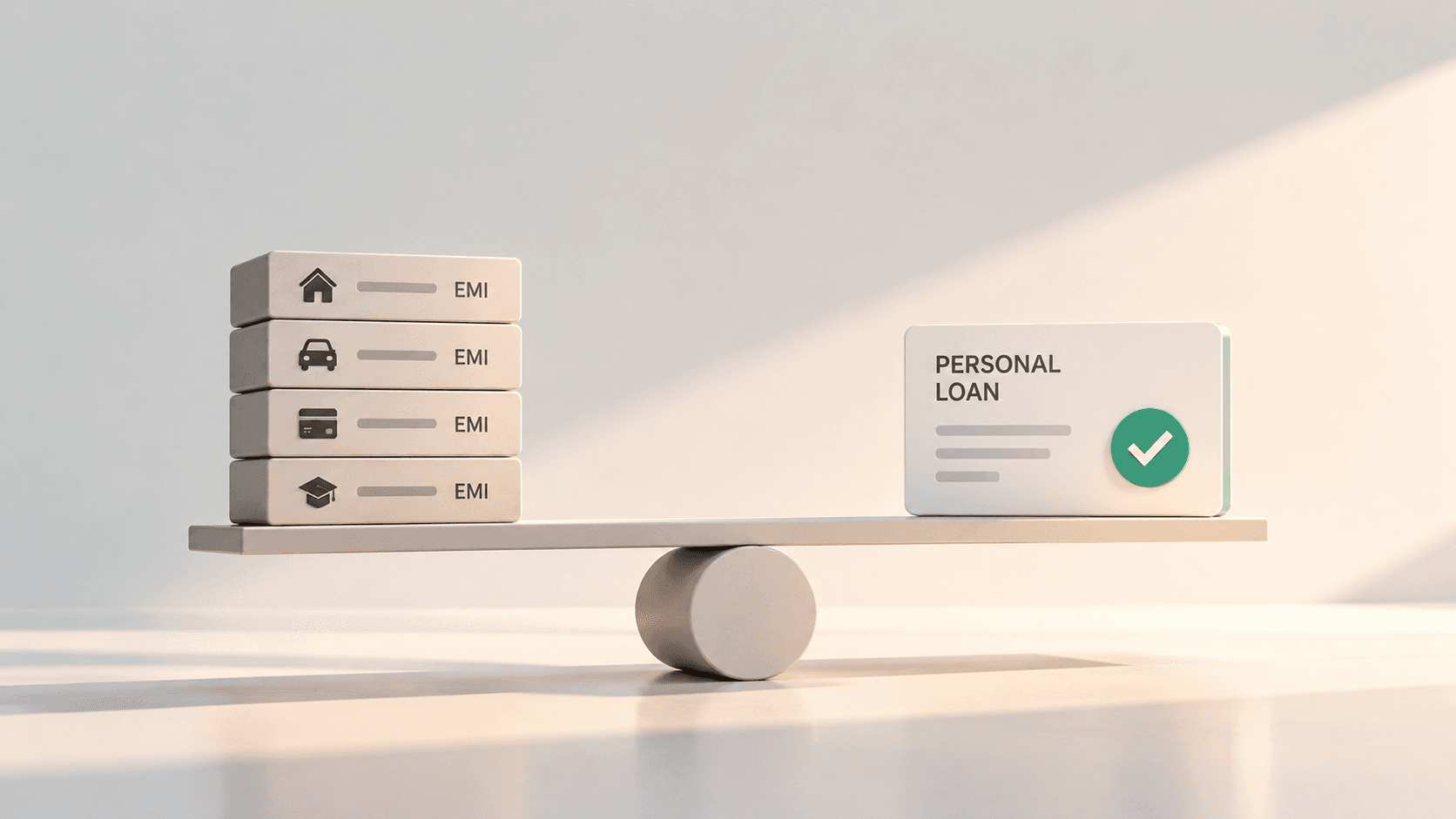
2. You Already Have Too Many EMIs
Earning a decent salary does not automatically mean you can comfortably take another loan.
Lenders also look at how much of your monthly income is already committed.
Suppose your take-home income is ₹45,000 per month and you currently pay:
. Bike EMI: ₹6,000
. Consumer loan EMI: ₹5,000
. Existing personal loan EMI: ₹8,000
. Credit card payments: ₹5,000
A large part of your monthly income is already being used for debt repayment. Adding another EMI may put pressure on your budget.
This existing debt burden can become one of the major personal loan rejection reasons, even if you have never missed an EMI.
3. Your Income Is Not Stable Enough
Lenders generally want to see that you have a reasonably stable source of income from which future EMIs can be paid.
Frequent job changes, irregular salary credits, long gaps in employment or highly inconsistent business income can make repayment capacity harder to assess.
For example, someone earning ₹35,000 regularly every month may appear different from someone whose income changes from ₹15,000 one month to ₹60,000 the next.
This does not mean self-employed people or freelancers cannot qualify. It simply means the lender may assess income stability differently.
Unclear or inconsistent income is another common factor among personal loan rejection reasons.
4. Your Income Does Not Meet the Lender's Criteria
Every lender has its own eligibility rules.
One lender may consider your income sufficient while another may not. Your location, age, employment type, employer profile and current financial obligations can also affect the lender's assessment.
For example, earning ₹25,000 per month does not create an automatic right to receive a certain loan amount.
The lender still needs to decide whether your income can comfortably support the proposed EMI after considering your other commitments.
You can understand these checks better in Bridge's Personal Loan Eligibility: What Lenders Check guide.
5. You Applied for Credit Too Many Times
Applying repeatedly for new loans or credit cards within a short period may make your profile look credit-hungry to some lenders.
It can also result in several recent credit enquiries appearing on your credit report.
Suppose your loan gets rejected on Monday and you immediately approach four or five more lenders over the next few days. That may not solve the underlying reason behind the first rejection.
Instead, understand the possible personal loan rejection reasons, correct what you can and then consider applying selectively.
6. There Are Errors or Mismatches in Your Details
Sometimes the problem is not your income or credit behaviour.
Simple data mismatches can cause verification issues.
Common examples include:
. A different spelling of your name across documents
. Incorrect date of birth
. Wrong PAN details
. An old residential address
. Incorrect bank information
. Salary details that do not match supporting records
. An inactive or incorrect mobile number
If the lender cannot verify important information, the application may not move forward.
That makes incomplete or inconsistent information one of the easiest personal loan rejection reasons to prevent.
Always review the information you submit before continuing.
7. Your Bank Statement Raises Concerns
Your bank statement can provide lenders with useful information about your income and regular financial commitments.
For example, a lender may notice that your account frequently has a very low balance, regular EMI deductions are being returned, salary credits are inconsistent or existing obligations are high compared with your income.
One unusual transaction will not necessarily decide your application. The lender considers its own underwriting criteria and your overall profile.
However, your banking activity can contribute to personal loan rejection reasons when it suggests that taking on another EMI may be difficult.
8. Your Credit Profile Is Too New
Not having a long credit history is different from having a bad credit history.
If you have never used a loan or credit card before, the lender may have limited information about how you handle borrowed money.
Some lenders may still consider the application using other information such as income and employment. Others may have stricter credit requirements.
A limited credit history can therefore be one of the possible personal loan rejection reasons, depending on the lender's policy.
9. You Do Not Meet Basic Eligibility Requirements
Sometimes an application is rejected before detailed credit assessment because the borrower does not meet the lender's basic eligibility rules.
These can relate to factors such as:
. Age
. Residency
. Income source
. Employment category
. Serviceable location
. Required documents
. Bank account verification
Eligibility conditions vary between lenders.
Checking the basic requirements first can help you avoid unnecessary applications and reduce avoidable personal loan rejection reasons.
Why Can a Loan Be Rejected Even With a Good Credit Score?
A strong credit score can help, but it does not guarantee loan approval.
A lender looks at more than one number.
Consider two borrowers who both have a good credit score.
Rohit earns ₹50,000 per month and already pays ₹25,000 in monthly EMIs.
Aman also earns ₹50,000 but pays only ₹7,000 in existing EMIs.
Even with similar credit scores, their ability to take another EMI is different.
Income, debt obligations, employment, verification, credit history and the lender's own policies can all affect the decision.
That is why focusing only on your score can cause you to miss other personal loan rejection reasons.
What Should You Do After a Personal Loan Rejection?
Do not immediately submit the same details to several other lenders.
First, look for the likely reason.
Check your credit report for overdue accounts or incorrect information. Calculate your existing monthly EMIs. Review your income records and bank details. Make sure the information in your documents matches what you submitted.
If your debt burden is already high, reducing an existing balance before taking more credit may improve your financial position.
If the issue is incorrect documentation, correct it before your next application.
If your credit history contains missed payments, rebuilding consistent repayment behaviour can take time.
The important point is to address the underlying personal loan rejection reasons rather than simply sending more applications.
Can Bridge Help After Your Loan Is Rejected?

Bridge can help you explore loan options available through its lending partners based on the information you provide.
However, Bridge is not the lender and does not make the final approval decision.
The relevant lending partner evaluates your profile and decides the approval, eligible amount, applicable interest rate, tenure and other loan terms.
There is no guarantee that using Bridge will result in approval.
Before proceeding, it is better to understand your current financial profile and avoid applying for more credit than you can comfortably repay.
How Can You Reduce the Chances of Rejection?
You cannot guarantee approval, but you can avoid several preventable personal loan rejection reasons.
Check your credit report before applying. Pay existing EMIs and card bills on time. Avoid unnecessary simultaneous credit applications. Enter your personal and financial information carefully. Keep your income and banking records ready for verification.
Most importantly, consider whether the new EMI fits comfortably into your monthly budget.
Borrowing should solve a financial need without creating a repayment problem later.
Final Takeaway
There is no single answer to why a personal loan gets rejected.
The most common personal loan rejection reasons include missed repayments, heavy existing EMIs, unstable income, credit-report issues, repeated applications, verification problems and failure to meet a lender's eligibility rules.
Instead of immediately applying again, identify the part of your profile that may have caused the problem.
Fixing the underlying issue can be more useful than sending multiple new applications with the same financial profile.
Bridge can help borrowers connect with its lending partners and explore available options, but the relevant lender makes the final credit decision.
Frequently Asked Questions
Q1. Does personal loan rejection reduce my credit score?
The rejection itself is not the same as a missed repayment. However, applications can involve credit enquiries, and repeatedly seeking new credit within a short period can affect how lenders assess your profile. Avoid making unnecessary applications simply because the first lender declined you.
Q2. How soon should I apply again after rejection?
There is no universal waiting period that works for every borrower. First understand the likely reason for rejection. If incorrect documents caused the problem, you may be able to correct them quickly. If the issue involves repayment history or high existing debt, improving your profile may require more time.
Q3. Can my loan be rejected because of my employer?
Possibly. Some lenders consider employment type, stability and other employer-related information as part of their internal eligibility rules. These policies differ between lenders.
Q4. Can incorrect information in my credit report cause rejection?
It can influence a lender's assessment if the incorrect information affects your reported repayment history, outstanding debt or other important details. Review your credit report and raise a dispute with the relevant credit bureau if you identify genuine errors.
Q5. Can I get a loan after being rejected by another lender?
Possibly. Different lenders can use different eligibility and underwriting policies. A rejection from one lender does not automatically mean every lender will reject your application. However, it is still better to understand the original personal loan rejection reasons before making another application.
Q6. Does Bridge approve or reject my loan?
No. Bridge is a technology platform and facilitator. It helps connect borrowers with lending partners. The lending partner reviews your information and decides whether to approve the loan and what terms, if any, to offer.